Ask Sarge — Central Florida Roofing Questions, Answered
Real, straight answers from Sal "Sarge" Ybarra and the State Certified Roofing crew — covering the roofing, insurance, code, gutter, and financing questions Ocala and The Villages homeowners ask most. Don't see yours? Call (352) 696-8989 and ask Sarge directly.
How much does a new roof cost in Ocala or The Villages, FL?
A new asphalt-shingle roof in the Ocala / The Villages area typically runs about $12,000–$18,000, or roughly $525 per square turn-key with State Certified Roofing — including architectural shingles, tear-off, permit, and haul-away. Final cost depends on size, pitch, and material.
How much does roof repair cost in Florida?
Most roof repairs in Central Florida run from about $400 for a simple fix to $3,000+ for extensive storm or leak damage. We give a free written estimate after inspecting, and tell you honestly whether a repair or replacement makes more sense.
How long does a roof replacement take?
Most residential roof replacements in Central Florida take 1–3 days, depending on roof size, complexity, and weather. We tear off, dry-in, and finish quickly to keep your home protected.
Roof Lifespan & Inspections
How long does a roof last in Central Florida?
An asphalt-shingle roof in Central Florida usually lasts 15–20 years — shorter than the national average because of intense heat, UV, humidity, and storms. Metal roofs last 40–70 years.
What are the signs I need a new roof?
Watch for curling, cracked, or missing shingles; granules collecting in gutters; ceiling stains or attic leaks; daylight through the roof boards; and age (15+ years). A free inspection confirms whether you need repair or replacement.
How often should I have my roof inspected in Florida?
Have your roof professionally inspected once a year and after every major storm. Annual inspections catch small issues before they become leaks and help keep your insurance in good standing. Our inspections are free.
What is the Florida 15-year roof insurance rule?
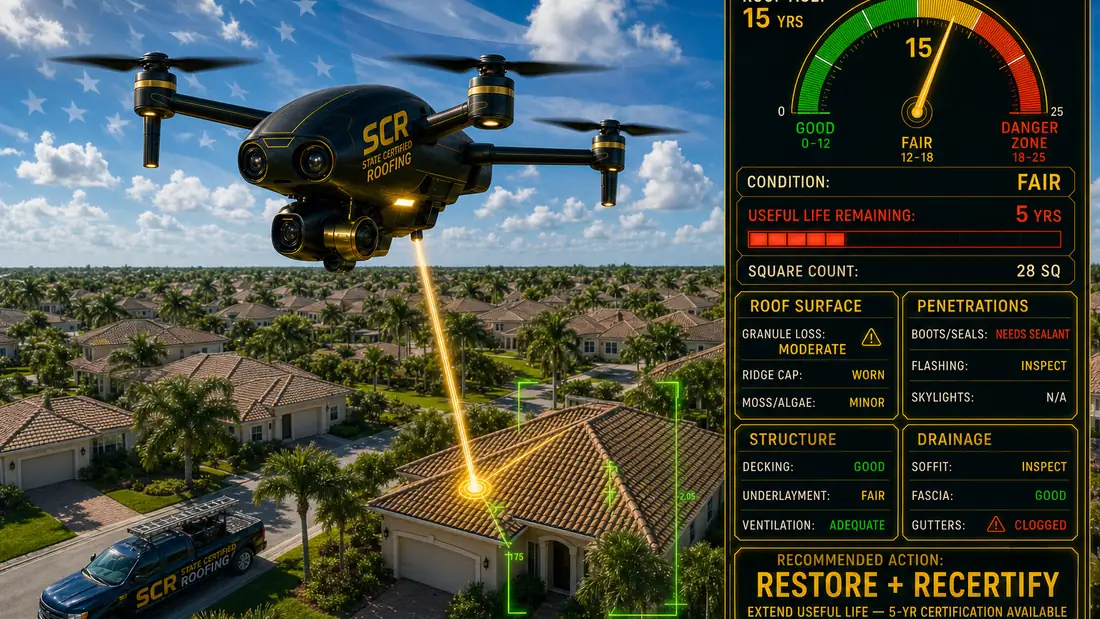
Under Florida law, insurers generally cannot refuse to renew a policy solely because a roof is over 15 years old if it has 5+ years of useful life left, proven by inspection. A current inspection report protects your coverage around that 15-year mark.
Hiring a Roofer
What should I ask before hiring a roofing contractor in Florida?
Ask for the contractor's state license number (verify it on Florida's DBPR portal), proof of workers' comp and liability insurance, a line-item written quote (shingle brand, underlayment, drip edge), the warranty terms, who supervises the job, and the payment schedule. State Certified Roofing gives you all of that up front — licenses CCC1334499 · CRC1335172.
What's a fair payment schedule for a roof?
A fair schedule is a deposit, a mid-project payment, and the balance after the job passes final inspection. Never pay the full amount upfront.
Do you replace the plywood/decking too?
If we find soft spots, water damage, or rot during tear-off, yes — we replace the bad sheathing so your new roof sits on a solid, code-compliant base. We show you exactly what we find before we cover it up.
Florida Codes & Insurance Savings
Do I need a permit to replace my roof in Florida?
Yes — nearly all roof replacements and larger repairs require a permit (rules vary by county). Unpermitted work can get insurance claims denied and trigger fines. We pull the permit and schedule the required inspections for you.
What is a wind mitigation inspection and why does it matter?
It's a 45-minute-to-2-hour inspection of your roof covering, deck attachment, roof-to-wall connections, roof shape, and opening protection. The results can cut your insurance premium 10–45% — we'll point you to a certified inspector.
What are hurricane straps and do I need them?
Hurricane straps (roof-to-wall connections) tie your roof framing to your walls to resist wind uplift. The cheapest time to add or upgrade them is during a roof replacement (about $1,000–$2,000), and they unlock major insurance discounts. Note: a new roof does NOT automatically upgrade these connections — ask us to check.
Will a new roof lower my home insurance?
Often yes — a newer roof plus wind-mitigation features (straps, sealed deck, impact-rated materials) can significantly lower premiums and keep carriers from dropping you.
Insurance Claims
Does homeowners insurance cover roof replacement in Florida?
Yes — Florida insurance typically covers roof replacement when damage is from a covered sudden event like a storm, hurricane, hail, or fallen tree. Age and normal wear usually aren't covered. We document the damage and work directly with your adjuster.
Can I choose my own roofing contractor for an insurance claim?
Yes. Florida law gives you the right to choose your own licensed contractor — your insurer cannot require you to use their preferred vendor. Pick a contractor who represents your interests, not theirs.
Materials
Should I get a metal or shingle roof in Florida?
Asphalt shingles last about 15–20 years and cost less upfront; metal roofs last 40–70 years and stand up to Florida sun and storms better, but cost more. We install both and help you weigh budget vs. longevity.
What shingle brands do you install?
We install premium architectural shingles from GAF, Owens Corning, and CertainTeed — your roof, your choice.
What are the black streaks on my roof?
Those streaks are algae (Gloeocapsa magma), very common in Florida humidity. They're mostly cosmetic but can be cleaned and treated — and roof rejuvenation can extend your roof's life for a fraction of replacement cost.
Gutters & GatorGuard
Do I need gutters in Florida?
Yes — with about 53 inches of rain a year, Florida homes need gutters to protect the foundation, fascia, and landscaping. Seamless 6-inch aluminum gutters handle Florida downpours best.
What is GatorGuard, and are gutter guards worth it in Florida?
GatorGuard™ is our micro-mesh gutter-protection system built for Florida's heavy pine-needle and oak debris, which clogs gutters 3× faster than most states. Guards are worth it here because clogs cause fascia rot and foundation damage — GatorGuard starts around $25/ft installed.
Soffit, Fascia & Siding
What's the difference between soffit and fascia?
Fascia is the vertical board along your roof edge that gutters attach to; soffit is the vented panel underneath the eaves that ventilates your attic. They work together to seal and ventilate the roofline — and both rot quickly in Florida humidity if damaged.
Financing & Grants
How can I get a new roof with little or no money down?
Three stacking options: PACE financing (paid through your property taxes, no credit score), Enhancify (soft-credit-pull financing up to $100K, rates as low as 0%), and the My Safe Florida Home grant (up to $10,000). Combined, these can bring out-of-pocket cost close to $0.
What is the My Safe Florida Home grant?
My Safe Florida Home offers eligible homeowners up to $10,000 in matching grant funds to harden their home against hurricanes — including roof and opening protection. It's a grant, not a loan, and homeowners 60+ are processed first.
Storm & Emergency
What should I do if my roof is leaking during a storm?
Move your family away from the area, put a bucket under the drip, and call a 24/7 emergency roofer immediately — Sarge answers at (352) 696-8989. Fast tarping stops the damage from spreading, and we document everything for your claim.
Do you offer 24/7 emergency roof repair?
Yes — we provide 24/7 emergency roof repair across Marion, Lake, and Sumter counties. We tarp and stop the leak fast, then schedule the permanent repair and handle insurance documentation.
About State Certified Roofing
Is State Certified Roofing licensed and insured?
Yes — we're fully licensed and insured, carrying Florida licenses CCC1334499 (roofing) and CRC1335172 (residential contractor). We're veteran-owned, BBB A+ rated, and based in Belleview, FL.
What areas do you serve?
We serve Ocala, The Villages, Belleview, Summerfield, Lady Lake, Leesburg, Wildwood, Fruitland Park, Silver Springs and all of Marion, Lake, and Sumter counties in Central Florida.
Got a Question Sarge Didn't Cover?
Ask away — real answers from a licensed, veteran-owned roofer. No pressure, no obligation. Serving Ocala, The Villages & all of Central Florida.
Every homeowner asks me the same thing: "Do I really need a new roof, or can we just fix it?" Fair question. There's a lot of money between those two answers, and plenty of roofers will steer you toward the expensive one whether you need it or not.
Here's how I think it through. Three numbers. Get these on the table and the decision usually makes itself.
Number 1 — The age of your roof
How old is the roof, and how much life is left in it? A standard asphalt shingle roof in Florida is fighting sun, heat, and storms its whole life — most give you somewhere around 15 to 25 years, and our climate is hard on the low end of that. If your roof is 8 years old, it's got a lot of road left and a repair protects a roof that's nowhere near done. If it's 22 years old, you're near the finish line no matter what we do today.
Number 2 — The cost of the repair
What does it cost to fix the actual problem, and does the fix solve it for years or just buy a few months? A localized repair — a section of shingles, some flashing, a few sheets of decking — can be a smart, honest fix on a roof with life left. But if I'm chasing leaks across an old roof, patching one spot just moves the next leak somewhere else.
Number 3 — The cost of replacement, against the life you'd buy back
What's a full replacement cost, and how many years of worry-free roof does it buy? A new roof resets the clock to 20-plus years, often gets you a better insurance position, and stops the slow bleed of repair after repair.
Now put them together — the honest math
Repair makes sense when the roof is young-to-middle-aged, the damage is localized, and the repair cost is a small fraction of replacement. You're protecting a roof with years left. That's money well spent.
You're throwing good money after bad when the roof is near the end of its life AND the repair is creeping toward a meaningful chunk of replacement cost. If you're spending 30-40% of a new roof to patch a roof that's got two or three years left, you're paying a lot to delay the inevitable — and you'll likely pay again next storm season.
The gray zone is a middle-aged roof with a real but fixable problem. That's where you want a roofer who'll show you photos, give you both numbers, and let you decide — not somebody who already filled out the replacement contract in the truck.
My promise on this: I'll give you the repair number AND the replacement number, with photos of what I'm actually looking at, and I'll tell you which one I'd choose if it were my own house. Sometimes the honest answer is "patch it and call me in five years." I've said it plenty of times. A roof you don't need isn't a sale I want.
Every roof is different — these are rules of thumb, not a guarantee. The real answer comes after I get up there and look. — Sarge
"It comes with a warranty" sounds great until something goes wrong and you find out which warranty you actually had. There are two of them on most roofs, they cover different things, and the fine print is where people get surprised. Here's the honest breakdown.
How many warranties are on a new roof?
Two, and they're not the same thing:
The workmanship warranty — that's the roofer. It covers the labor and installation.
The manufacturer warranty — that's the company that made the shingles or materials. It covers defects in the product itself.
You want both, and you want to understand the difference.
What does the workmanship warranty (the contractor's) cover?
This is my work — how the roof was installed. If a leak shows up because of how the roof was put on (flashing done wrong, nails in the wrong spot, a detail missed), the workmanship warranty is what makes it right. The honest truth about roofs: most leaks in the early years aren't bad shingles — they're bad installation. So this is the warranty that protects you day-to-day.
Durations vary a lot by contractor — some offer a couple of years, some offer ten or more. What matters as much as the number of years is whether the contractor is still going to be around and standing behind it. A 25-year workmanship warranty from a company that folds in three years is worth nothing. Ask how long they've been in business before you put weight on the warranty length.
What does the manufacturer warranty (the shingles') cover?
This covers the materials — if the shingles themselves are defective from the factory. Standard shingle warranties often run long on paper (you'll see "lifetime" or "30 years"), but read how it works: most are prorated, meaning the payout shrinks as the roof ages, and they typically cover the cost of the defective material — not the labor to tear off and reinstall.
Here's the part the brochure won't lead with: a manufacturer warranty usually only holds up if the roof was installed correctly, to the manufacturer's specs, by a qualified installer. Sloppy installation can void it. So the two warranties are connected — good installation is what keeps the material warranty alive.
What voids a roof warranty?
Common ways folks lose coverage, on either warranty:
Bad or unpermitted installation — cuts corners and can void the manufacturer warranty outright.
Walking on the roof, pressure washing, or DIY repairs that damage shingles.
Letting another contractor work on the roof without coordinating — a second roofer cutting into my work can end my workmanship warranty, and theirs may not cover the original.
Adding things to the roof (satellite dishes, solar, mounts) drilled in wrong.
Lack of maintenance — ignoring obvious problems until they cause bigger damage.
Not registering the manufacturer warranty when registration is required — some have to be filed within a window after install.
What should I actually ask for?
Get it in writing. Before you sign, ask any roofer:
How long is your workmanship warranty, and what exactly does it cover?
How long have you been in business — are you going to be here to honor it?
What manufacturer warranty comes with these specific shingles, is it prorated, and does it cover labor or just material?
Do I need to register anything, and will you handle it?
I'll put all of that in plain language on your paperwork. No mystery, no "trust me." If a roofer won't put the warranty terms in writing, that tells you what the warranty is really worth.
Warranty terms vary by product and contractor — always read the actual document for your roof. This is general guidance to help you ask the right questions. — Sarge
Request Your Free Inspection
No pressure. Straight answers. Sarge will follow up personally.